
Index on Censorship - výběrová bibliografie
Tuto výběrovou bibliografii zahraničního časopisu Index on Censorship, zaměřenou na československá témata z let 1972-1991, vypracoval Ondřej Valtus.
Na našem webu jsou dále dostupná některá čísla časopisu, která obsahují především články týkající se zemí východního bloku a Sovětského svazu; ne články o spisovatelích a svobodě projevu v dalších zemích Západu a světa.
 |
| Kliknout pro zvětšení |
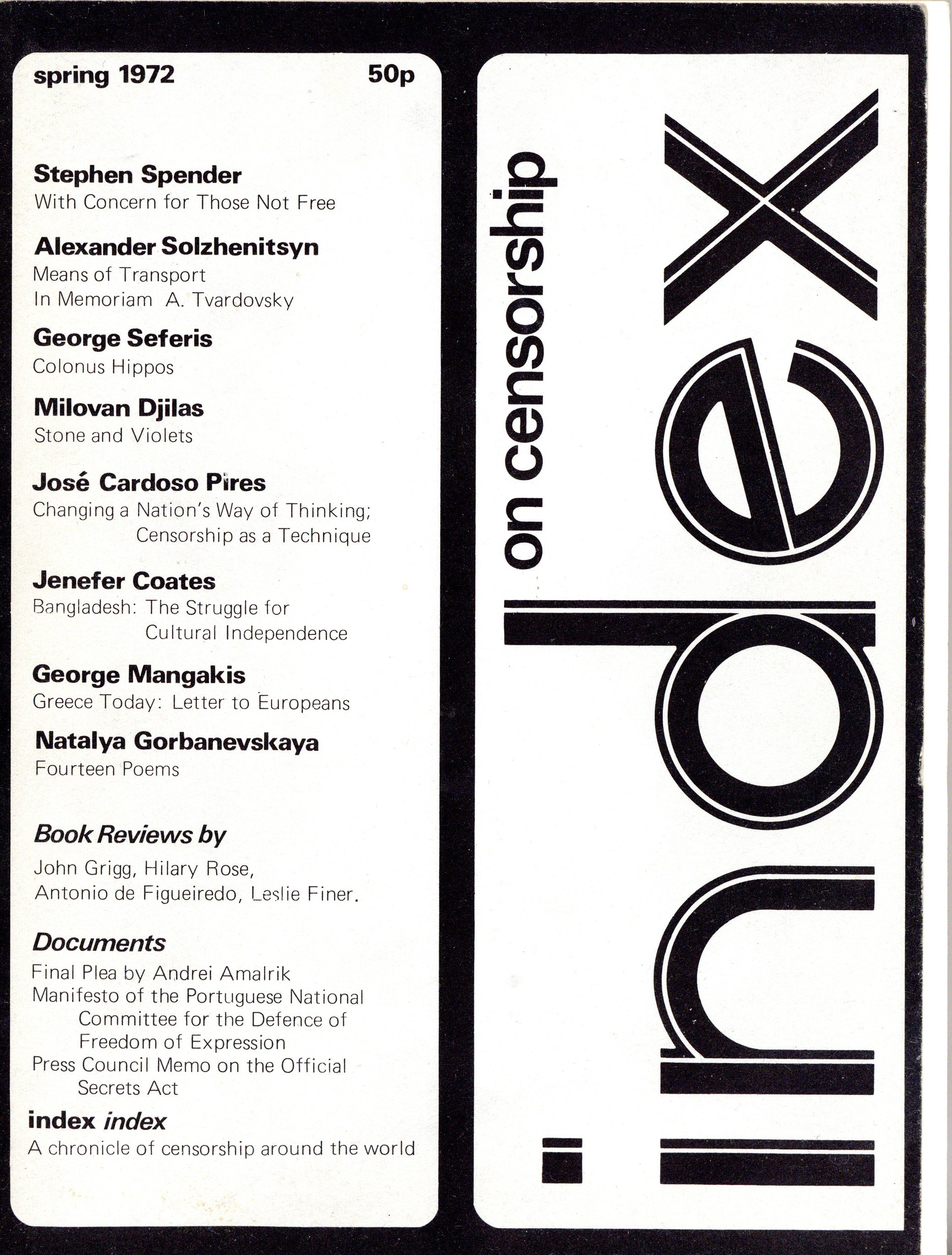
Vol. 1, No. 1, Spring 1972
- Stephen Spender: With Concern For Those Not Free. (s. 11–15)
- Film Censorship: Czechoslovakia. (s. 77–78)
- Index: Czechoslovakia. (s. 82)
- Daniel Weissbort: The Ordeal of Natalya Gorbanevskaya. (s. 117–123)
- Antonio de Figueiredo: Writers Against Rulers by Dušan Hamšik. (s. 156–158)
Vol. 1, No. 2, Summer 1972
- Czechoslovakia and Cuba. (s. 10–11)
- Brossa and Vaculík. (s. 12–13)
- Peter Payne: Four Years of ‘Normalisation’. The Academic Purge in Czechoslovakia. (s. 33–52)
- Index: Czechoslovakia. (s. 90)
- Ludvík Vaculík: The Guinea-pigs (an extract). (s. 153–159)
Vol. 1, No. 3–4, Autumn/Winter 1972
- Óndra Łysohorsky: Eighteen Poems. (s. 44–56)
- Ewald Osers: Ondra Lysohorsky, the Obstinate Non-conformist. (s. 57–65)
- Index: Czechoslovakia. (s. 114–116)
- Writers & Journalists in prison – May 1972, Czechoslovakia. (s. 160)
- James Atlas: From the Diary of a Counterrevolutionary by Pavel Kohout. (s. 236–238)
Vol. 2, No. 1, Spring 1973
- Jiří Hochman: Barber Novak’s dictatorship from the unpublished novel ‘Stag Ford’. (s. 71–80)
- Index: Czechoslovakia. (s. ii–iii)
- The complete text of two documents instructing Czech librarians on how to censor and classify their holdings. (s. 104–108)
Vol. 2, No. 2, Summer 1973
- Ludvík Vaculík: I can’t complain. An interview with the Czech novelist by Friedrich Rentsch. (s. 47–56)
- Index: Czechoslovakia. (s. ii)
- Anti-socialist ‘happenings’ in Czechoslovakia. (s. 94)
- The death of Zora Jesenská (obituary). (s. 94–95)
Vol. 2, No. 4, Winter 1973
- Anonymous: Messages from Czech prison. In letters to his wife, smuggled out of prison, one of the victim of Dr Husák’s ‘normalisation’ describes the everyday existence of political detainees in Czechoslovakia. (s. 64–72)
- Jiří Müller: Complaint concerning the violation of law no. 59/65 of the penal code. Czech student leader, jailed for 5 ½ years, accuses the prison authorities of infringing the law. (s. 73–78)
- Jan Neústupný: Letter from Czechoslovakia. A political and cultural terror without parallel – a Czech writer’s view of life in his country five years after the invasion. (s. 78–82)
- Royalty robbery in Czechoslovakia. From Country Report No. 1 – Czechoslovakia, published by PEN American Centre in August 1973. (s. 79)
- An interview with František Janouch by Peter Taylor. An excerpt from an interview on This Week, broadcast by Thames Television on 25 July 1973. (s. 80)
- An interview with Ludvík Vaculík by Peter Taylor. An excerpt from an interview on This Week, broadcast by Thames Television on 25 July 1973. (s. 80)
- An interview with Věněk Šilhán by Peter Taylor. An excerpt from an interview on This Week, broadcast by Thames Television on 25 July 1973. (s. 91)
- Death of Václav Renč. (s. 91)
- Banned books in Czechoslovakia. (s. 93–97)
- Óndra Łysohorsky: The Death of W. H. Auden. (s. 123)
Vol. 3, No. 1, Spring 1974
- “I want to write”. The Czech playwright Pavel Kohout in an interview on Austrian television, published in Frankfurter Rundschau on 28 September 1973. (s. 34)
- Index: Czechoslovakia. (s. ii–iii)
Vol. 3, No. 2, Summer 1974
- Czechoslovakia 1974: A strange way to criticise Graham Greene. (s. 61–64)
- Index: Czechoslovakia. (s. ii–iii)
- Czechoslovakia: Checkmate for Pachman? (s. 75–76)
Vol. 3, No. 3, Autumn 1974
- George Moldau: Preserving a nation’s morale. The Czech dilemma. (s. 36–40)
- Pachman not allowed to play. (s. 39)
- Index: Czechoslovakia. (s. ii–iii)
- Amnesty report: Writers and journalists in prison – Czechoslovakia. (s. 80)
- Czechoslovakia: Bearing witness. (s. 93–94)
Vol. 3, No. 4, Winter 1974
- Anonymous: The Czechoslovak underground press. A brief review of the little-known Czech samizdat. (s. 47–51)
- Milan Kundera: Life is elsewhere (extract). (s. 53–62)
- Index: Czechoslovakia. (s. i–ii)
Vol. 4, No. 1, Spring 1975
- Anonymous: The five commandments. How the West can help persecuted intellectuals. (s. 17–18)
- Czech trials. (s. 44)
- Czechoslovakia: Hypocrisy. (s. 74–76)
- Index: Czechoslovakia. (s. 84)
Vol. 4, No. 2, Summer 1975
- Boycott: A matter of personal taste or public principle? – A. J. Liehm. (s. 28)
- George Schöpflin: Czechoslovakia – Writers and rulers. (s. 76)
- Forgive us our frankness. (s. 78)
- Index: Czechoslovakia. (s. 86–87)
Vol. 4, No. 3, Autumn 1975
- Asserting himself. (s. 16)
- Jaroslav Seifert: Fifteen sonnets on Prague. (s. 17–25)
- George Schöpflin: East Europe: Leaning on dissidents – Czechoslovakia. (s. 72)
- Czechoslovakia: Three banned generations. (s. 73–76)
- Czechoslovakia: Who is afraid of Franz Kafka? (s. 76–77)
- Index: Czechoslovakia. (s. 80)
Vol. 4, No. 4, Winter 1975
- Ludvík Vaculík: Impermissible thoughts. A Czech writer’s appeal to UN Secretary General Kurt Waldheim. (s. 12–14)
- Robert C. Porter: Freedom is my love. The works of Milan Kundera. (s. 41–46)
- Vlastimil Hora and Michael David: Intimidation. (s. 50–52)
- Vilém Prečan: Bound, gagged and robbed. An open letter to participants in the World Congress of Historians in San Francisco, August 1975. (s. 53–57)
- Karel Kosík: ‘I am dead and yet I live’. An open letter to Jean-Paul Sartre. (s. 57–58)
- Index: Czechoslovakia. (s. 70)
Vol. 5, No. 1, Spring 1976
- Pavel Kohout: Who owns culture? An open to Heinrich Böll and Arthur Miller, autumn 1975. (s. 75)
- Index: Czechoslovakia. (s. 82)
Vol. 5, No. 2, Summer 1976
- Věra Chytilová: I want to work. The text of a letter from Věra Chytilová, a leading Czech film director, to President Gustav Husák, 8 October 1975. (s. 17–20)
- Index: Czechoslovakia. (s. 84)
Vol. 5, No. 3, Autumn 1976
- Czechoslovakia: 8 years after: Introduction. Four case histories: Václav Havel, Ondra Lysohorský, Vlasta Chramostová, a woman journalist. (s. 17–19)
- H. Hermann: A historical note. (s. 19–20)
- Ivan Kraus: ‘The Censor’ and ‘The Crowd’ (stories). (s. 21–22)
- Petru Popescu: Prague 1968. (s. 22)
- Alan Levy: “The reed that bends but never breaks”. Why has Czechoslovakia not followed Hungary’s example and eased its restrictions? (s. 23–28)
- Jan Hrachor: Fear of words. The paradox created by a restrictive regime, which forces writers to play a political role. (s. 29–33)
- O. Sojka: The bounds of silence. The choices open to Czech writers after eight years of ‘normalization’. (s. 34–40)
- Václav Havel: ‘Conversation’. First publication in English of Havel’s new one-act play. (s. 41–50)
- V. Šimek: Seven lean years. The present state of Czech theatre. (s. 51–54)
- Václav Havel: Much ado… The playwright’s letter to Prague officials on the police action against amateurs who performed his Beggar’s Opera. (s. 55–56)
- J. Liehm: Triumph of the untalented. The decline of Czech film-making since 1968. (s. 57–60)
- B. Novák: Silenced singer. The story of Marta Kubišová. (s. 61–62)
- B. Novák: Wasted lives. An appeal by the relatives of Czech political prisoners and extracts from their letters from prison. (s. 63–70)
- Index: Czechoslovakia. (s. 80)
Vol. 5, No. 4, Winter 1976
- Index: Czechoslovakia. (s. 81–82)
Vol. 6, No. 1, January/February 1977
- Jiří Otava: Religious freedom in Czechoslovakia. Interviews with priests and laymen lead the author to conclude that political dissenters and religious believers share similar problems. (s. 24–28)
- Index: Czechoslovakia. (s. 60–61)
Vol. 6, No. 2, March/April 1977
- Index: Czechoslovakia. (s. 64)
Vol. 6, No. 3, May/June 1977
- Vilém Prečan: A society in crisis. A Czech historian discusses the significance of Charter 77 and explains why the official reaction to this human rights manifesto has been so hysterical. (s. 26–29)
- Franklin Jordan: Bad interpreters. (s. 29)
- Milan Šimečka: Hostage. How people in Czechoslovakia are pressured into signing condemnations of the Charter. (s. 29–30)
- Charter 77. The full text of the Prague manifesto. (s. 31–33)
- Newspeak: Favourable balance. (s. 32)
- Newspeak: Obsolete people. (s. 33)
- Index: Czechoslovakia. (s. 66–67)
- Late News: Czechoslovakia. (s. 73)
Vol. 6, No. 4, July/August 1977
- Ludvík Vaculík: A cup of coffee with my interrogator. One of the many feuilletons circulating in Prague, this describes the author’s encounters with the secret police last January. (s. 3–6)
- Czechoslovakia: Facilitating the flow. (s. 65)
- Index: Czechoslovakia. (s. 68–69)
Vol. 6, No. 5, September/October 1977
- Index: Chechoslovakia. (s. 66–67)
Vol. 6, No. 6, November/December 1977
- Milan Kundera: Comedy is everywhere. The Czech novelist discusses the problems (and compansations) of a writer in exile, the contribution made by Central Europe to the world’s art and culture, the drawbacks of ‘committed’ literature, and ‘the death of the novel’. (s. 3–7)
- Andrei Amalrik & others: Is détente working? Replies to an Index questionnaire n what has been – or is likely to be – achieved by the 1975 Final act. (s. 44–51)
- Index: Czechoslovakia. (s. 64)
Vol. 7, No. 1, January/February 1978
- Václav Havel: Breaking the ice barrier. In a clandestinely filmed interview in Prague, the author gives his view on his trial and on the significance of Charter 77. (s. 25–28)
- Czechoslovakia: More Padlock Publications. (s. 63)
- Index: Czechoslovakia. (s. 67)
Vol. 7, No. 2, March/April 1978
- Alan Levy: Karel Gott as Hamlet. Not even pop singers are immune from government pressures, as is shown by the case of Czechoslovakia’s top male singer who was induced to return from West Germany and conform to the rules which apply in his ‘normalized’ homeland. (s. 33–39)
- Index: Czechoslovakia. (s. 58)
Vol. 7, No. 3, May/June 1978
- Arthur Miller: The sin of power. The author uses the example of Czechoslovakia to show how dictatorship of the Left and Right commit ‘the sin of power’ by distorting reality to suit their propaganda aims. (s. 3–6)
- Step by Step. The text of a letter sent by 13 Czech writers to their friends and colleagues in the West. (s. 5)
- Ladislav Hejdánek: Will I be on TV? One of the spokesmen for Charter 77 describes his treatment at the hand of the Czech secret police. (s. 11–13)
- Pavel Kohout: Unwelcome guests. The well-known playwright tells how he and other ‘Chartists’ tried unsuccessfully to attend this year’s Railwaymen’s Ball. (s. 13–15)
- Ludvík Vaculík: Free to use a typewriter. The text of the forewords to two volumes of Czechoslovak Feuilletons – two of the 100 ‘Padlock Publications’ circulating in Prague. (s. 35–37)
- Alexander Kliment: Mr Feuilleton. One of the many literary pieces from ‘Padlock’, this describes the life of a banned Prague journalists – a newspaperman without a newspaper. (s 37–38)
- Robert Hardy: A Prague odyssey. (s. 55–56)
- Index: Czechoslovakia. (s. 62–63)
Vol. 7, No. 4, July/August 1978
- Index: Czechoslovakia. (s. 66)
- Zlatko Parič: A slow process. A German anthology of statements and studies by leading dissidents and Western socialists on the recent upsurge of human rights movements in Eastern Europe. (s. 76–78)
Vol. 7, No. 5, September/October 1978
- Ludvík Vaculík: My philosophers. An amusing 50th birthday tribute to the banned Czech philosopher, Karel Kosík, this one of the texts in Vaculík’s collection, ‘Czechoslovak Feuilletons’. (s. 9–11)
- Czechoslovakia: Ridiculous action. (s. 59)
- Index: Czechoslovakia. (s. 65)
- Igor Hájek: A remote hope. The 10th anniversary of the Prague Spring saw the publication, in Paris, of Dix ans après, whose author is Dubček’s Foreign Minister, Dr Jiří Hájek. (s. 77–78)
Vol. 7, No. 6, November/December 1978
- Eduard Goldstücker: Profile: Jiří Gruša. The 40-years-old poet and novelist, whose latest book, The Questionnaire, is a major contribution to Czech literature, was arrested on 1 June and faces trial on charges of ‘incitement’. (s. 49–51)
- Index: Czechoslovakia. (s. 61)
Vol. 8, No. 1, January/February 1979
- Legend and reality. (s. 43)
- Index: Czechoslovkia. (s. 58–59)
Vol. 8, No. 2, March/April 1979
- Index: Czechoslovakia. (s. 64–65)
Vol. 8, No. 3, May/June 1979
- George Moldau: ‘Patočka University’. (s. 54–56)
- Index: Czechoslovakia. (s. 66)
Vol. 8, No. 4, July/August 1979
- Index: Czechoslovakia. (s. 64)
Vol. 8, No. 5, September/October 1979
- Cecil Parrott: Jaroslav Seifert – poet of everyday life. The biography of Czechoslovakia’s greatest living poet whose brave stand for writer’s freedom in 1956 and again after the 1968 invasion has put him on the black list. (s. 20–23)
- Jaroslav Seifert: And now goodbye. The septuagenarian poet’s farewell with which he ends his major recent work, The Plague Column. (s. 23)
- Milan Šimečka: Home-made books. A banned writer’s thoughts on reading Seifert’s latest work in the typescript Padlock edition. (s. 24–25)
- Vladimír Holan: A night with Hamlet. Excerpt from a long poem by another leading Czech poet whose work cannot be printed in his country. (s. 26–27)
- Josef Škvorecký: Heroes old and new. What kind of literature is being published in Prague today, when almost all the best writers are banned? The author, himself exiled in Canada, gives three examples which are ‘a subject for the psychiatrist rather than the literary scholar’. (s. 28–30)
- Jiří Gruša: The Questionnaire. Excerpt from the novel which caused Gruša’s arrest last year – one of the most brilliant books by a Czech author since the war. (s. 31–36)
- Expert testimony: Gruša’s Questionnaire. The report given to the Prague police by two ‘literary experts’ on Gruša’s The Questionnaire. (s. 37–38)
- Ludvík Vaculík & Václav Havel: Controversy: Why go to jail? Vaculík’s feuilleton ‘Some reflections on bravery’ last December caused a major controversy among Czech dissidents. We publish his text and Havel’s reply. (s. 39–42)
- Visiting Václav Havel. (s. 41)
- Jaroslav Hutka: Now listen Socrates. One of the texts by a leading Czech singer and songwriter now living in Holland. (s. 52)
- Kathleen V. Wilkes: Helping Plato survive. (s. 56–57)
- New Padlock titles. (s. 62–63)
- Index: Czechoslovakia. (s. 65)
Vol. 8, No. 6, November/December 1979
- Index: Czechoslovakia. (s. 64)
- Igor Hájek: Underground records. Discs made recently in the West give an insight into the rock, pop and protest song scene in Czechoslovakia. (s. 72–73)
Vol. 9, No. 1, February 1980
- Index: Czechoslovakia. (s. 68–69)
Vol. 9, No. 2, April 1980
- Index: Czechoslovakia. (s. 68–69)
Vol. 9, No. 3, June 1980
- Index: Czechoslovakia. (s. 62–63)
- Mark Frankland: Goulash Archipelago. Recent books on life in Eastern Europe show how different – for all the similarities – the various Communist countries are. (s. 71–74)
Vol. 9, No. 4, August 1980
- Index: Czechoslovakia. (s. 69)
Vol. 9, No. 5, October 1980
- Jan Čech: Poets and pigs feeders. Article written for Index by a Prague author – the tragic story of censored verse and persecuted poets since 1948. (s. 21–23)
- Index: Czechoslovakia. (s. 62)
Vol. 9, No. 6, November 1980
- Index: Czechoslovakia. (s. 66)
Vol. 10, No. 1, February 1981
- Ivan Klíma: The girl athlete. A macabre short story by one of Czechoslovakia’s best-known silenced writers. (s. 27–33)
- Index: Czechoslovakia. (s. 71)
Vol. 10, No. 2, April 1981
- Index: Czechoslovakia. (s. 72)
Vol. 10, No. 3, June 1981
- Milan Šimečka & Miklós Harasti: Poland: What the neighbours think. A banned Czech writer compares the Polish crisis and the Prague Spring of 1968, while several Hungarians answer Haraszti’s questions on the Polish events. (s. 4–10)
- Safe in Canada. (s. 5)
- Denis Cox: Really? (s. 6)
- Denis Cox: Certainly not! (s. 7)
- Francis Wheen: Not oppressive? (s. 7)
- Michael Bourdeaux: In the catacombs. (s. 15)
- Index: Czechoslovakia. (s. 73)
Vol. 10, No. 4, August 1981
- J. Liehm: Thaws, booms and blacklists. Freedom from market pressures, plus political uncertainty, sometimes makes good cinema. (s. 9–12)
- No exit for Věra Chytilová. (s. 10)
- Index: Czechoslovakia. (s. 44–45)
Vol. 10, No. 5, October 1981
- H. Gordon Skilling: A Czech awakening. Under the rubble of ‘normalisation’ many intellectual and cultural activities lead an unofficial existence. (s. 24–25)
- Legal experts. (s. 25)
- T. G. Masaryk and our times. (s. 25)
- Index: Czechoslovakia. (s. 44)
Vol. 10, No. 6, December 1981
- Ivan Klíma: Variation on an eternal theme. (s. 12–13)
- Milan Kundera: Loss of identity. (s. 13)
- Jan Vladislav: A parallel world. (s. 14–16)
- Jan Vladislav. Homeland (poem). (s. 17)
- Tom Stoppard: Open letter to President Husák. (s. 18)
- Arthur Miler: A kind of despair. (s. 31–32)
- Jaroslav Seifert: The diamond monstrance. (s. 32–34, 66)
- Josef Škvorecký: Dvorak in love (excerpt). (s. 96–100)
- Jaroslav Krejčí: The origin of rights. (s. 103–104)
- Index: Czechoslovakia. (s. 106)
Vol. 11, No. 1, February 1982
- Index: Czechoslovakia. (s. 43)
Vol. 11, No. 2, April 1982
- Index: Czechoslovakia. (s. 44)
Vol. 11, No. 3, June 1982
- Václav Havel: Living in the lie. An excerpt from Power of the Powerless. (s. 34)
- Index: Czechoslovakia. (s. 43)
Vol. 11, No. 4, August 1982
- Jiří Gruša: In praise of Aunt Censorship. Why does a writer choose banning and exile rather than accept ‘the fate of those who are permitted to write’? A Czech poet and novelist explains. (s. 4–5, 10)
- Mary Benson: Open letter to Ivan Klíma. Inspired by a banned Czech author’s article in Index 6/1981, the exiled South African novelist describes her own feelings on becoming a ‘banned person’ in 1966. (s. 6–7)
- Index: Czechoslovakia. (s. 43–44)
Vol. 11, No. 5, October 1982
- Dušan Havlíček: Czech interlude. A former Czech press and TV official shows how to control of the media was consolidated 1948–1962 and then weakened during the Prague Spring in 1968. (s. 19–24)
- Index: Czechoslovakia. (s. 34)
Vol. 11, No. 6, December 1982
- Index: Czechoslovakia (s. 44)
Vol. 12, No. 1, February 1983
- Vratislav Brabenec & Ivan Jirous: Banned in Bohemia. Two members of the Plastic People – one now exiled, the other in jail – talk about their music and its persecution. (s. 30–34)
- George Theiner: Forbidden fruit from Uppsala. (s. 31)
- Ivan Jirous: The underground. (s. 33)
- Vratislav Brabenec: Police crackdown. (s. 33)
- Ivan Jirous: Living differently. (s. 33)
Vol. 12, No. 2, April 1983
- Opinion: Neal Ascherson on literature and repression. (s. 2, 41)
- Zdena Tominová: The typewriters hold the fort. ‘It was all done with the aid of typewriters and jogging’ – a former Charter 77 spokewoman describes the production of Czech samizdat. (s. 28–30)
- Václav Havel: Reflections on the theatre. A personal statement, sent out from prison, by Czechoslovakia’s foremost playwright. (s. 31–32)
- Jan Vladislav: All you need is typewriter. A Czech poet and publisher of a samizdat literary series recalls the dangers of unofficial publishing. (s. 33–35)
- Ludvík Vaculík: The spring is here. The author visits his birthplace, celebrates his teacher’s 90th birthday, and discusses life in various parts of the world. (s. 36–37)
- Ludvík Vaculík: Reluctant exile. (s. 37)
- Jiřina Šiklová: Save these books. An eloquent appeal to save Czech culture from destruction, written while in custody awaiting trial. (s. 37–39)
- Igor Hájek: Profile of Ivan Klíma. Banned since 1968, Klíma is one of Czechoslovakia’s finest novelists and short story writers. (s. 39–41)
- Index: Czechoslovakia. (s. 44)
Vol. 12, No. 3, June 1983
- Index: Czechoslovakia. (s. 43)
Vol. 12, No. 4, August 1983
- Opinion: Jan Vladislav on book-burners, ancient and modern. (s. 3)
- Index: Czechoslovakia. (s. 40–41)
Vol. 12, No. 5, October 1983
- Index: Czechoslovakia. (s. 43–44)
Vol. 12, No. 6, December 1983
- Václav Havel: ‘I take the side of truth’. The full text of the interview which Czechoslovakia’s leading playwright gave after his release from prison. (s. 3–6)
- Czechoslovakia: Ladislav Lis. (s. 41–42)
- Index: Czechoslovakia. (s. 44)
Vol. 13, No. 1, February 1984
- Milan Šimečka: A Czech Winston Smith. 1984 is now appearing in Czechoslovakia in samizdat with an introduction by dissident author Milan Šimečka. (s. 6–10)
- Vladimír Tosek: Jakubisko, London and Smith. Slovak film director Juraj Jakubisko praises the censor for destroying his films. (s. 10, 15)
- Samuel Beckett: Catastrophe. For Václav Havel. (s. 11–12)
- Václav Havel: Mistake. A sketch by Czechoslovakia’s top banned playwright. (s. 13–14)
- ‘Many thanks to our Swedish friends’. Václav Havel’s message for the Stockholm premiere of his latest play. (s. 15)
- Bedřich Placák: Peace and Freedom.
- Index: Czechoslovakia. (s. 42)
Vol. 13, No. 3, June 1984
- Karel Kyncl: A conversation with Graham Greene. (s. 2–6)
- Bohumil Hrabal: An ordinary day. This short story, written and hidden in 1953, found in 1971, remains unpublishable in Czechoslovakia. (s. 7–10)
- Karel Kyncl: Czech restraints. (s. 43)
- Index: Czechoslovakia. (s. 45)
Vol. 13, No. 4, August 1984
- Karel Kyncl: Doctor honoris causa Václav Havel. At Toulouse University Tom Stoppard accepted the diploma on Czech’s playwright’s behalf. (s. 6–8)
- Index: Czechoslovakia. (s. 39–40)
- Karel Kyncl: Central and Eastern Europe (Annual report). (s. 48)
Vol. 13, No. 5, October 1984
- Writers and repression. ‘They shoot writers, don’t they?’ was the title of a conference organized by Index on Censorship. (s. 28)
- George Theiner: How to foil the censor. (s. 30)
- Josef Škvorecký: A cabaret of censorship. (s. 38–41)
- Index: Czechoslovakia. (s. 43)
Vol. 13, No. 6, December 1984
- Index: Czechoslovakia. (s. 44)
Vol. 14, No. 1, February 1985
- Barbara Day: Theatre on a string. ‘An increasing number of performers from established theatres have begun to involve themselves in the fridge circuit’. (s. 34–36)
- Jiří Hanák: Top dog. (s. 36)
- Karel Kyncl: A censored life. The ‘Living Room Theatre’ in the home of Vlasta Chramostová – a leading Czech actress banned since 1969 – was an outstanding example of unofficial culture. (s. 37–42)
- Milan Uhde: The blue angel. One-person shows like this one are well suited to ‘underground’ performance. (s. 43–47)
- Index: Czechoslovakia. (s. 62)
Vol. 14, No. 2, April 1985
- Opinion by George Theiner: ‘How objective are we?’ (s. 2, 21)
- Jaroslav Seifert: A tribute to Vladimír Holan. Last year’s Nobel Prize winner pays homage to eight deceased Czech poets. (s. 4–7)
- Jan Vladislav: Poets and power: Jaroslav Seifert. How the Czech authorities have treated Jaroslav Seifert in the past 40 years. (s. 8–12)
- Jaroslav Seifert. In Lenin’s Mausoleum (poem). (s. 11)
- Index: Czechoslovakia. (s. 53)
Vol. 14, No. 3, June 1985
- VVK: Charter 77 in ’85. On its eighth anniversary, Charter 77 issues a statement redefining its aim and answering its critics. (s. 22–23)
- Index: Czechoslovakia. (s. 49)
Vol. 14, No. 4, August 1985
- George Pravda (obituary). (s. 4)
- Moravius: What the censors omitted. The cuts made in Jaroslav Seifert’s memoirs when they were last officialy published in Prague. (s. 15–17)
- Karel Michal: Purvis. ‘Supernatural’ short story by a Czech satirist who died in Switzerland. (s. 18–22)
- Index: Czechoslovakia. (s. 51)
- Karel Kyncl: Central and Eastern Europe (Annual report). (s. 59)
Vol. 14, No. 5, October 1985
- Iva Kotrlá: The fishing line. Short story and three poems. (s. 25–27)
- Index: Czechoslovakia. (s. 65)
Vol. 14, No. 6, December 1985
- Falsified photographs. Before and after: how undesirable people ‘disappeared’ from documentary photos. (s. 34–39)
- Index: Czechoslovakia. (s. 56)
Vol. 15, No. 1, January 1986
- Karel Kyncl: Dangerous rock. (s. 4)
- Rudolf Battěk: John Baker the evangelist. The prison writing of a leading dissident recently released after five and a half years in jail. (s. 17–20)
- Index: Czechoslovakia. (s. 33)
- Official voices from the European Cultural Forum. (s. 36)
- George Theiner: Last year in Budapest. Reflections and testimonies from a remarkable unofficial symposium. (s. 37)
- Timothy Garton Ash: Eloquent contrast. (s. 38)
- Pavel Kohout: Inhuman isolation. (s. 42)
- Jiří Gruša: Ex-prophets and story-sellers. Exiled Czech author on writers East and West. (s. 44–45)
- Czechoslovak writers and Charter 77 address the Budapest Cultural Forum (Charter 77 Document No 24/1985). (s. 54–55)
- A Besieged Culture. Writers, artists, journalists and scholars living in Czechoslovakia describe their situation today. (s. 56–65)
- Forbidden writers (a list). (s. 61)
- Jaroslav Seifert: Dangerous songs? An excerpt from a letter to Heinrich Böll, 16 August 1976. (s. 64)
Vol. 15, No. 2, February 1986
- Karel Kyncl: Jaroslav Seifert 1901–1986 (obituary). (s. 3)
- Karel Kyncl: Czech Catholics arrested. (s. 4)
- Index: Czechoslovakia. (s. 38)
Vol. 15, No. 3, March 1986
- Karel Kyncl: Václav Havel wins Erasmus Prize. (s. 3)
- Karel Kyncl: Videos, pirates and the underground. How videos are used to evade the state monopoly in Communist Europe, the Soviet Union and Chile; and why in Holland half the video trade is illegal. (s. 18–22)
- Ladislav Hejdánek: Offering a variety of views. Interview with Czech philosopher who holds ‘underground’ seminars. (s. 25–26)
- Karel Kyncl. The Nurse and the Poet. The extraordinary story of the poet Ivan Blatný, Czechoslovakia’s first non-person. (s. 27–30)
- Index: Czechoslovakia. (s. 38)
Vol. 15, No. 4, April 1986
- How it is in Prague. In an article entitled ‘It’s all bloody complicated…’ circulating in Prague samizdat, the exiled Czech writer Ota Filip, who lives in Munich, takes the side of young Czech authors and enters into an argument with a representative of the Czechoslovak Writers Union. (s. 4–5)
- Vilém Prečan: Pogrom of historians. How the writing of history was brought into line after the 1968 invasion. (s. 24–28)
- Short shrift for Einstein. (s. 24)
- Seeking the truth. (s. 25)
- Who can publish? (s. 26)
- Index: Czechoslovakia. (s. 37)
Vol. 15, No. 5, May 1986
- Václav Havel: A play’s fate. The banned Czech playwright, Václav Havel, taped a message for the Dutch audience of his one-act play Audience, which was performed in Amsterdam during the Index on Censorship/SLAA conference on 7–9 March. (s. 4–5)
- Let young people sing. (s. 6–7)
- Jan Stavinoha: Prague Dixieland. Short story by Czech writer living in Amsterdam. (s. 15–18)
- Index: Czechoslovakia. (s. 38)
Vol. 15, No. 6, June 1986
- Jan Pelc: It’s gonna get worse. Extract from an outspoken novel by an exiled young writer. (s. 27–30)
- Index: Czechoslovakia. (s. 37–38)
Vol. 15, No. 7, August 1986
- Ludvík Vaculík: Three feuilletons. Czech author comments on life in his country where he writes nder the ever-watchful eye of the secret police. (s. 12–16)
- 2,000 Words. (s. 12)
- Index: Czechoslovakia. (s. 41)
- Karel Kyncl: Central and Eastern Europe (Annual report). (s. 50–51)
Vol. 15, No. 8, September 1986
- Opinion by Karel Kyncl: What do people in Czechoslovakia really think. (s. 2, 6–7)
- Index: Czechoslovakia. (s. 37)
Vol. 15, No. 9, October 1986
- Karel Kyncl: Rap music and all that jazz. (s. 3)
- Ivan Klíma: Judge on trial. Denied publication for 18 years, Klíma nevertheless continue to live and write in Prague. We publish an extract from his latest novel. (s. 26–30)
- Index: Czechoslovak. (s. 47)
Vol. 15, No. 10, November 1986
- Václav Havel: My temptation. Interview, in which the banned Czech playwright explains how he came to write his latest two plays. (s. 19–21)
- Václav Havel: Temptation. (s. 22–43)
- Index: Czechoslovakia. (s. 44–45)
Vol. 16, No. 1, January 1987
- Jiří Ruml: Ten years of Charter 77. Banned Czech journalist and Charter member reviews its activities since its foundation in January 1977. (s. 9–12)
- Index: Czechoslovakia. (s. 39)
Vol. 16, No. 2, February 1987
- Appeals for Jazz Section. (s. 3–4)
- Index: Czechoslovakia. (s. 37)
Vol. 16, No. 3, March 1987
- Index: Czechoslovakia. (s. 37)
Vol. 16, No. 4, April 1987
- ‘Glasnost’ in Central and Eastern Europe. (s. 7–8)
- Pavel Kohout: Double trouble. Story about two policemen bugging a Prague writer’s home. (s. 13–16)
- Index: Czechoslovakia. (s. 35–36)
Vol. 16, No. 5, May 1987
- Index: Czechoslovakia. (s. 37)
Vol. 16, No. 6, June 1987
- Karel Kyncl: Hope and reality in Prague. (s. 6, 9)
- Ludvík Vaculík: Happy Easter. Czech writer’s ironic view of Moscow’s new-found ‘openness’. (s. 7–8)
- Zdeněk Mlynář: If Gorbachev lived in Prague… (s. 7)
- Ivan Klíma: Refusing to be silenced. (s. 8)
- Jan Pelc: Fraternal assistance – twenty years on. In this satirical story, the USSR is invaded by its East European allies to put an end to glasnost. (s. 9)
- Index: Czechoslovakia. (s. 36–37)
Vol. 16, No. 7, August 1987
- Index: Czechoslovakia. (s. 36–37)
Vol. 16, No. 8, September 1987
- Peter Brod: Bohumil Hrabal back in the Writers Union. (s. 5–6)
- ‘Asigment: Eastern Europe.’ (s. 6)
- Why Prague? (s. 6)
- Karel Kyncl: Vladimov’s dog. How a Czech reader of Russian samizdat discovered who was the author of Faithful Ruslan. (s.26–29)
- Index: Czechoslovakia. (s. 36)
Vol. 16, No. 9, October 1987
- Index: Czechoslovakia. (s. 35)
Vol. 16, No. 10, November–December 1987
- Opinion by Jan Vladislav: Why do they write? (s. 2, 19)
- Peter Brod: Glasnost: Eastern Europe. There are great differences between the countries’ policies concerning the mass media and censorship. (s. 27–29)
- Index: Czechoslovakia. (s. 36–37)
Vol. 17, No. 1, January 1988
- Bohumil Hrabal: Mr. Stránský’s good luck. Excerpt from Hrabal’s latest book, giving a frank account of the Soviet poets, some of whom remain unpublished despite glasnost. (s. 15–18)
- Index: Czechoslovakia. (s. 37)
Vol. 17, No. 2, February 1988
- Ludvík Vaculík: A day in August. Mikhail Gorbachev’s letter to Milan Šimečka, safely posted in Prague, somehow fails to arrive. (s. 16–17)
- Index: Czechoslovakia. (s. 35–36)
Vol. 17, No. 3, March 1988
- Acta. The ‘Documentation Centre for the Promotion of Independent Czechoslovak Literature’ has started to publish an English edition of its quarterly magazine ACTA. (s. 6)
- Václav Havel: Stories and totalitarianism. One of Czechoslovak’s most distinguished writers, who is also banned, reflects on the destruction of a ‘basic instrument of human knowledge and self-knowledge’. (s. 14–21)
- Index: Czechoslovakia. (s. 38)
Vol. 17, No. 4, April 1988
- Karel Kyncl: Josef Lada, before and after. The wall calendars of the illustrator of The Good Soldier Schweik, as amended by a government artist. (s. 12–13)
- Index: Czechoslovakia. (s. 36)
Vol. 17, No. 5, May 1988
- Religious marches broken up. (s. 5)
- Ludvík Vaculík: In praise of the censor. (s. 42–43)
- Ivan Klíma: Crime and paradox. (s. 44–47)
- Václav Havel: Letter to Vienna. (s. 46–47)
- Milan Uhde: Yes, we have no machine-guns. (s. 47–48)
- František Pavlíček: Flunkeys and chameleons. (s. 48–49)
- Milan Jungmann: Non-reality. (s. 49–50, 54)
- Jan Trefulka: Orwell 1987/88. (s. 50–52, 54)
- Milan Šimečka: Black holes. (s. 52–54)
- Questionnaire, with replies from: Eva Kantůrková, Zdeněk Urbánek, Iva Kotrlá, Jaromír Šavrda, Vilém Hejl, Vlasta Chramostová, Jaromír Hořec, Rudolf Battěk. (s. 56–69)
- Index: Czechoslovakia. (s. 127)
Vol. 17, No. 6, June–July 1988
- Vladimír Mlynář: Where is my play? (s. 4)
- Karel Kyncl: In memoriam Pavel Wonka. (s. 4–5)
- Index: Czechoslovakia. (s. 35)
Vol. 17, No. 7, August 1988
- In memoriam George Theiner. Václav Havel, Jan Vladislav, Ludvík Vaculík, Hana Pravdová, Pavel Tigrid, Jiří Pelikán, Karel Janovický, Shaun Johnson, Mark Bonham Carter, Michael Scammell, Zuzaa Blüh, Ivan Klíma. (s. 2–5, zadní obálka)
- Index: Czechoslovakia. (s. 34)
Vol. 17, No. 8, September 1988
- Index: Czechoslovakia. (s. 44–45)
Vol. 17, No. 9, October 1988
- More glasnost inside the Czechoslovak CP? (s. 6)
- Index: Czechoslovakia. (s. 36–37)
Vol. 17, No. 10, Decemeber 1988
- Index: Czechoslovakia. (s. 36)
Vol. 18, No. 1, January 1989
- Philip Spender: George/Jiří Theiner. (s. 6)
- Sally Laird: Prague autumn. The editor of Index on Censorship describes what happened when she went to a banned symposium in Prague. (s. 26–30)
- Karel Kyncl: Ivan Jirous. (s. 28)
- Karel Kyncl: In Vienna. (s. 30)
- Milan Šimečka: Our prospects. In a paper prepared for ‘Czechoslovakia 88’ symposium, a banned Czech philosopher looks at his country’s prospects before the year 2000. (s. 30, zadní obálka)
- Index: Czechoslovakia. (s. 34–35)
Vol. 18, No. 2, February 1989
- Index: Czechoslovakia. (s. 36–37)
Vol. 18, No. 4, April 1989
- Karel Kyncl: Václav Havel and the others. (s. 5–6)
- Milan Uhde: The Annunciation. First publication of a comedy by the banned playwright. (s. 18–34)
- Index: Czechoslovakia. (s. 37)
- Pavel Bém: At the corner I saw… This is an account of the events in Wenceslas Square in Prague in mid-January, as they were experienced by Dr Pavel Bem MD, who, as he admits in his piece, has gone to Wenceslas Square out of curiosity. (zadní obálka)
Vol. 18, No. 5, May/June 1989
- Index: Czechoslovakia. (s. 37–38)
Vol. 18, No. 6 & 7, July/August 1989
- Havel released. (s. 3–4)
- Ivan Hoffman: Out loud in Bratislava’s smog. A report on an attempt to alert citizens to the disaster on their doorsteps by publishing ‘out loud’ in samizdat the governent’s own whispered facts and figures. (s. 60–61)
- Karel Kyncl: Too little too late? Index’s researcher looks at the official response to Czechosovakia’s grave environmental problems. (s. 62–63)
- Index: Czechoslovakia. (s. 77–78)
Vol. 18, No. 8, September 1989
- A few words from Czechoslovakia. (s. 3–4)
- Index: Czechoslovakia. (s. 36–37)
Vol. 18, No. 9, October 1989
- Václav Havel: Thank you, friends. (s. 3)
- Lidové noviny. A statement issued by the Czechoslovak independent newspaper Lidové noviny (‘The People’s Paper’), 28 August 1989. (s. 4)
- Index: Czechoslovakia. (s. 36–37)
***
Vol. 18, No. 10, November–December 1989
- Prague protest. (s. 5–6)
- Karel Kyncl: Birthday greetings. (s. 6)
- Karel Kyncl: Magyar diary. (s. 18–19)
- Barbara Day: Unbelievable story of waiters. Review of I served the King of England by Bohumil Hrabal. (s. 35)
- Index: Czechoslovakia. (s. 37)
Vol. 19, No. 1, January 1990
- Index: Czechoslovakia. (s. 36)
Vol. 19, No. 2, February 1990
- Opinion by Václav Havel: Between outcast and politician. (s. 3–4)
- Václav Havel and Samuel Beckett. (s. 4)
- Index: Czechoslovakia. (s. 35–36)
Vol. 19, No. 3, March 1990
- Opinion by Karel Kyncl: Sun of free expression. (s. 2)
- Index: Czechoslovakia. (s. 36)
- Welcome freedom. (zadní obálka)
Vol. 19, No. 4, April 1990
- Sign of the changing times. (s. 28)
- Obituary: Ondra Lysohorsky (s. 32)
- Index: Czechoslovakia. (s. 35)
Vol. 19, No. 5, May 1990
- Philip Spender: Václav Havel and Index. (s. 1)
- Index: Czechoslovakia. (s. 35)
Vol. 19, No. 6, June/July 1990
- Ivan Kuptík: The unknown tastes sweeter. Six months ago the chances were nil that Index might reprint an article from the official Czech Communist Party newspaper Rudé právo which criticized censorship and listed its bad points. (s. 15–16)
- Index: Czechoslovakia. (s. 37)
Vol. 19, No. 9, October 1990
- Index: Czechoslovakia. (s. 37)
Vol. 19, No. 10, December 1990
- Karel Kyncl: Pavlov, Prague airport, and the sleepwalker’s memories of going home. The return to a country that was one’s own, after seven years in exile, produces great elation and deep depression, historical and personal. This was the experience of Karel Kyncl in April and August this year. (s. 30–33)
- Karel Kyncl: Milan Šimečka. (s. 32)
- Index: Czechoslovakia. (s. 35)
Vol. 20, No. 1, January 1991
- Index: Czechoslovakia. (s. 35)
Vol. 20, No. 2, February 1991
- Index: Czechoslovakia. (s. 36)
Vol. 20, No. 3, March 1991
- Petr Hames: Pictures from olden times. When the curtain rose on the ‘lost’ work of Czech cinema, it revealed a treasure trove of rare delights. (s. 25–26)
- Beggar’s opera 1990. (s. 26)
Vol. 20, No. 4 & 5, April/May 1991
- Ivan Klíma: No Blood for Oil (one-act play). (s. 49–51)
- Index: Czechoslovakia. (s. 53)
Vol. 20, No. 6, June 1991
- Index: Czechoslovakia. (s. 37)
Vol. 20, No. 7, July 1991
- Index: Czechoslovakia. (s. 35)
Vol. 20, No. 8, August/September 1991
- Index: Czechoslovakia. (s. 51)
Vol. 20, No. 9, October 1991
- Index: Czechoslovakia. (s. 35)